Wearable Technology: Protecting the Future in Electronic Developments
"Wearable" – a term that was predominantly associated with the clothing industry is now trending for a whole new reason. Harnessing the electronic functions used in everyday life and incorporating them into devices and accessories that can comfortably be worn on the body, is leading us into the era of #wearables, #wearabletech.
Everyone is talking about wearable technology and with such a wide scope of applications and products the industry is expected to see another large growth in 2015. In fact, for 2014, the wearables market was forecast to be worth over £300m within the UK market; the second highest prediction in Europe after Germany. The developments are continuing at a rapid rate too, with predictions such as this one by Gartner, that by as soon as 2017, 30% of wearable devices will be completely unobtrusive to the eye.
In all types of use, the technology is designed to make us more efficient; in business, the ongoing development of smart watches for example, will allow multi-tasking, process tracking and increased involvement during travel and when on the move. In our personal lives, devices such as health bands and fitness trackers will help us to understand our everyday activities better in order to improve our health. There are also a number of new developments taking place, showing the use of wearable technology in different industries. For example, within the fashion industry companies such as CuteCircuit are designing interactive clothing where the colour or design can be controlled via smart phone apps or twitter feeds. Utilising such technology within clothing has also expanded further into high visibility or safety accessories by companies such as Visijax.
Analysis and research are also key factors within the wearable technologies industry. In sport, there are seemingly endless possibilities to analyse and improve one’s game. Whether it be via the use of Google Glass to aid performance within the sport, navigate a route and send a message during training or by the use of many other sensor based devices that can analyse technique, speed or posture for example; wearable technology provides the opportunity to develop and improve at a much faster rate. In the medical industry the ability to analyse and treat patients using wearable technology is also offering new avenues of research and is extending into ingestible devices. It is clear that the applications that can develop within this field are seemingly endless.
The technologies that such wearable devices are utilising are already common place, however and are being adapted for their use in new applications. For example, the devices usually have to connect to a smart phone or computer in order to relay information or data. As a result, the wearable devices may have wireless or Bluetooth connectivity or as with navigation devices, may incorporate GPS. In addition, a number of applications for wearable technology may use sensors to detect a specific change (which is dependent on the nature of the sensor) and provide an output which again may be transferred to a separate receiver.
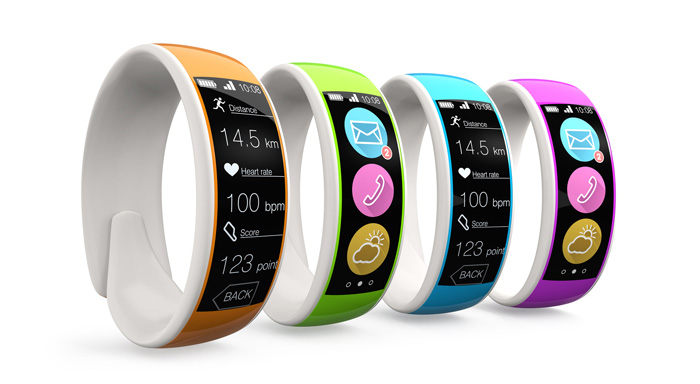
Alongside the challenge of actually designing a functioning device, the challenge that wearable technology poses is the nature in which this technology will be used and primarily, the environments that the device may be used in. For instance, a temperature sensor on a static device will have to withstand the temperatures within that environment and any thermal shock or cycling that may take place. A temperature sensor in a wearable device has the added consideration of physical interactions; the device will be moved, worn, may see impact, may be flexed and potentially exposed to a number of additional elements, such as water or chemicals, for example. It is therefore imperative that these devices are protected accordingly to ensure reliable performance when utilised in their end-use environments.
Protection can be provided in the form of encapsulation resins or conformal coatings, for example. The variety of potential applications can also generate another challenge in selecting the most suitable protection compound. As we have already concluded, the wearable device is likely to use some form of connectivity, whether it be direct to another device or system or via a sensor to record changes in information gathered. This connection to other devices will operate via radio waves and therefore any protection compound used, must allow RF signals to be transmitted without any interference. In connection with this requirement the environmental conditions and general use of the device must be considered in order to produce a full picture of its working life.
To enable a better understanding of likely performance and simplify the selection process, it is possible to draw on experience from other industries and technologies. For instance, if we think of a wearable device that can be worn by a swimmer to monitor heart rate and general health when in the pool, it is immediately understood that this device must still work when immersed in water. Any changes in temperature will be minimal but quite rapid and the frequency and length of time the device could be immersed in water is unknown. It should therefore be assumed that the device is constantly operating when immersed in water. This application can be likened to that of a sonar buoy used in marine applications where sensors are utilised for providing vital information about the sea environment. In this case, the device will have to send an RF signal and operate when constantly immersed in salt water; a similar environment to that of the wearable health tracker worn by the swimmer.
We can also elaborate on the information we have already gained from other industries. For example, salt water is generally more corrosive than the water found in a swimming pool and therefore the application experience gained from the sonar buoys will show the performance of a device protected with a suitable compound, such as Electrolube UR5041, in a similar but more aggressive environment. This is obviously just one example of many different considerations; the degree of flex and toughness of the device, the operating temperature range and the possibility of any chemicals coming into contact with the device are all possible factors to take into account during the selection process. Thinking about all of these properties and not forgetting the need to allow connectivity via RF signals, there are many properties such as the dielectric constant, salt mist resistance, shore hardness and elongation at break that can be used to find the optimal product for in-use testing.