As electronic products become smaller, lighter and more complex, protecting their internal components presents a growing challenge. Yet these printed circuit boards and electronic assemblies may still need to operate in environments containing moisture, condensation, oils, dust, chemicals and other contaminants.
Nano coatings offer a potential solution. These ultra-thin surface treatments can provide valuable environmental protection while adding minimal weight and thickness to an assembly. They are increasingly considered for compact electronics, wearable devices, sensors and other applications where traditional coatings may be too bulky or may interfere with sensitive components.
However, nano coating is not simply a thinner version of every other coating technology. Its structure, application process and protective capabilities can be significantly different from those of liquid conformal coatings and potting compounds.
This guide explains what nano coatings are, how they work, where they may be used and how they compare with other established methods of protecting electronic assemblies.
What is a nano coating?
A nano coating is an extremely thin layer of material applied to a surface to change or improve its functional properties. One nanometre is one-billionth of a metre, and coatings described as nano coatings may be only nanometres or a few microns thick, depending on the material and application process.
The term covers a broad range of technologies. Some nano coatings form a continuous polymer film at the molecular level. Others use nanoparticles or nano-scale surface structures to create a particular function, such as water repellency, oil repellency, corrosion resistance, reduced friction or improved scratch resistance.
In electronics, nano coatings are commonly selected to help protect components and assemblies against moisture and contamination. They may be engineered to be:
- Hydrophobic, meaning they repel water
- Oleophobic, meaning they resist oils
- Dielectric, providing an electrically insulating barrier
- Anti-Corrosive, helping to reduce contact between vulnerable surfaces and environmental contaminants
The result is a functional surface treatment that may be almost invisible and that generally has very little effect on the weight or dimensions of the coated product.
Understanding the structure of a nano coating
The structure of a nano coating depends on both its chemistry and its application method. In many electronics applications, the coating consists of a very thin, highly cross-linked polymer network bonded to the surface of the assembly.
Unlike a conformal coating, which builds a measurable protective film over the assembly, a nano coating forms an ultra-thin surface treatment that follows the existing topography with minimal material build-up. It covers exposed board surfaces, component bodies, solder joints and conductors at a microscopic scale without creating a substantial build-up of material.
Some nano coatings work primarily by altering surface energy. Water or oil is less able to wet the treated surface, so it forms droplets rather than spreading into a continuous film. This can be particularly useful in electronics because a continuous layer of contaminated moisture may contribute to corrosion, leakage currents or the formation of conductive paths.
Other systems create a more conventional barrier, physically separating the underlying substrate from moisture, chemicals or corrosive contaminants. The exact level of protection will depend on the coating chemistry, film continuity, adhesion, coverage and operating environment.
This distinction is important. The word “nano” describes the scale of the coating or its engineered structure, but it does not automatically define its performance. Two nano coatings may offer very different levels of water repellency, electrical insulation, chemical resistance and durability. Nano coatings should therefore be assessed against the requirements of the finished product rather than selected on thickness alone.
How are nano coatings applied?
Nano coatings are applied using a dip-coating process. The complete assembled circuit board, including all its components, is submerged in a specially formulated coating solution. It is then removed and allowed to drain, ensuring that any excess material runs off before the coating is heat-cured.
Because the nano coating forms an extremely thin layer, there is no need to mask connectors, sensors or other components before application. The entire board assembly can be coated without the heavy material build-up associated with many conventional coatings, allowing the components to continue working as intended. Once the coating has been cured, the board has a complete protective layer across its surfaces and around its components.
Nano coatings are particularly well suited to high-volume production environments. Because the coating is applied to the entire assembly without the need for masking sensitive components, there is no subsequent de-masking or touch-up work required. This significantly reduces processing time and handling, enabling large numbers of boards to be coated quickly and efficiently while maintaining consistent protection across every assembly.
Surface preparation remains important. Flux residues, oils, dust and contamination from handling should be removed before dipping, as these can affect how well the coating bonds to the board.
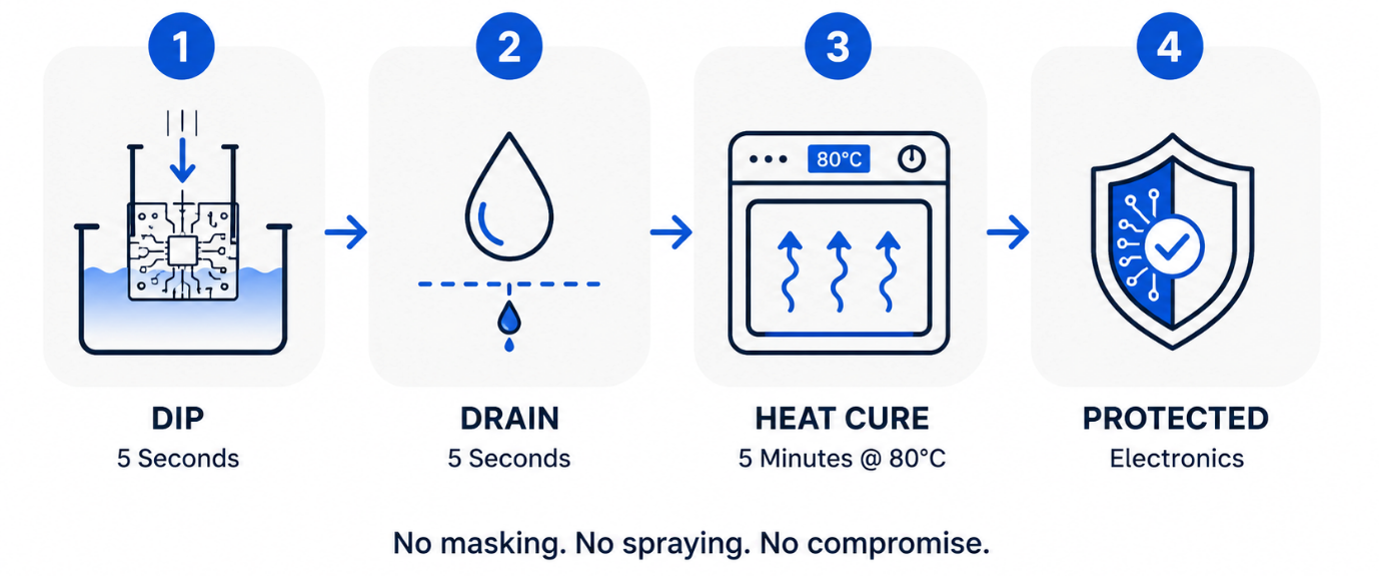
Image credit: NanoFlowX
Where can nano coatings be used?
Nano coatings are particularly suitable for small, lightweight electronic assemblies where space is limited or where a thicker coating could affect the function of individual components. They can be used across a wide range of applications, including wearable technology, consumer electronics, automotive systems, medical devices and industrial sensors.
The dip-coating process is also well suited to high-volume production. As masking is not required and multiple circuit boards can be dipped at the same time, large quantities can be processed quickly and efficiently. This makes nano coatings a practical option for manufacturers that need consistent protection across high production volumes.
Wearable and portable technology
Wearable devices may be exposed to perspiration, humidity, rain, cosmetics and skin oils. A nano coating can provide moisture and contamination resistance without significantly increasing the size or weight of the product.
Its thin structure also makes it suitable for compact assemblies containing tightly spaced components, microphones, sensors, switches and other features that may not tolerate a heavy coating.
Consumer electronics
Smartphones, headphones, smart-home devices and portable accessories may encounter accidental splashes or humid conditions during normal use. Nano coatings can form one part of the product’s moisture-protection strategy while preserving the appearance and dimensions of the assembly.
A coating on the electronics should not, however, be treated as an automatic guarantee that the complete product is waterproof. Enclosure design, seals, connectors, assembly methods and the severity and duration of exposure must all be considered.
Automotive and transport electronics
Vehicle electronics can experience humidity, condensation, oils, temperature changes and corrosive contaminants. Nano coatings may be useful for lightweight sensors, control electronics, displays and connected devices where a thick layer would be undesirable.
For areas exposed to heavy vibration, prolonged chemical contact or continuous immersion, a more mechanically robust protective system may still be required.
Medical and monitoring equipment
Compact monitoring products and portable medical electronics may benefit from a lightweight coating that helps resist moisture and contamination. Material compatibility, cleaning chemicals, sterilisation processes and any applicable regulatory requirements must be evaluated carefully for the intended device.
Industrial sensors and Internet of Things devices
Sensors and connected devices are increasingly installed in outdoor, agricultural, manufacturing and energy applications. Their electronics may be exposed to condensation or airborne contaminants while needing to remain small and sensitive.
A well-selected nano coating can help protect these assemblies with minimal effect on dimensions, but the environmental conditions and expected service life should be validated through appropriate testing.
Nano coating compared with conformal coating
Conformal coating is a thin protective polymer film applied to an assembled PCB. Common material families include acrylic, silicone, polyurethane, epoxy and parylene. Conventional liquid conformal coatings are often applied by spraying, dipping, brushing or selective automated equipment before being cured.
Like a nano coating, conformal coating follows the shape of the board and its components. Both technologies can protect against moisture, contaminants and corrosion while adding relatively little weight compared with potting.
The principal difference is usually film thickness and the way in which protection is achieved. A typical liquid conformal coating may be tens or hundreds of microns thick, while a nano coating may be considerably thinner. This gives nano coatings an advantage where dimensional impact, weight, flexibility or access to very small features is critical.
Conformal coatings may offer a more substantial physical barrier, with well-established material options for chemical resistance, elevated temperatures and different levels of reworkability. They can also be inspected using established production methods, including visual and UV inspection where fluorescent tracers are present.
Nano coatings can be harder to see and measure because the deposited layer is so thin. Process validation and suitable inspection techniques are therefore essential. Neither option is universally better. The correct choice depends on the environment, assembly design, required standards and acceptable maintenance strategy.
PFAS-Free Coating Options
As environmental awareness and regulatory scrutiny around per- and polyfluoroalkyl substances (PFAS) continue to increase, manufacturers are increasingly seeking alternative coating technologies that deliver effective protection without the use of fluorinated chemicals. One example is NanoFlowX VX3, a non-PFAS nano coating developed as an alternative to traditional fluoropolymer coatings such as FPC, which are no longer widely available. VX3 is designed for many of the same electronics applications and provides protection against moisture, salt fog, corrosion and environmental contamination while maintaining an ultra-thin coating thickness of approximately 4 µm. The coating achieves IP67 and IP68 levels of waterproof protection, is safe for use on connectors, requires no masking during application and remains reworkable after processing. For manufacturers looking to maintain the performance benefits traditionally associated with fluoropolymer nano coatings while reducing potential environmental and human health concerns linked to PFAS substances, PFAS-free nano coatings offer a practical and increasingly attractive alternative.
Choosing the correct protection
Selecting between nano coating and conformal coating should begin with a detailed understanding of the product’s operating environment.
Important questions include:
- Will the assembly encounter humidity, condensation, splashes or immersion?
- Which chemicals, oils or cleaning agents could reach the electronics?
- Are there strict limits on weight, dimensions or coating thickness?
- Are connectors, microphones, sensors or contact areas particularly sensitive?
- What temperatures and thermal cycles will the assembly experience?
- Which industry and customer standards apply?
- What production volume and process controls are required?
Testing should reproduce the anticipated service conditions as closely as possible.
An ultra-thin solution to a complex challenge
Nano coatings provide designers and manufacturers with another valuable option for protecting modern electronic assemblies. Their ultra-thin structure makes them particularly suitable for compact, lightweight and geometrically complex products where conventional coating thickness could affect functionality.
They are not, however, a direct replacement for every conformal coating or potting compound. Conformal coatings offer a broad range of established material properties and application options, while potting remains a strong choice where mechanical reinforcement and a substantial environmental barrier are required.
The most reliable solution is the one matched to the product, its environment and its expected service life. By considering these factors early in the design process and validating the selected coating through representative testing, manufacturers can reduce the risk of premature failure while avoiding unnecessary material, weight and processing.
Need help selecting a protective coating?
The most appropriate coating process will depend on your PCB design, operating environment, production volume and performance requirements. Chiltern Connections can help evaluate the available options and develop a controlled protection process for your electronic assemblies.
Contact us to discuss your application.